
Is Propolis Safe? Allergies, Children, Pregnancy, Medicines and Pets
It is one of the questions we are asked most often, and it is a fair one. Propolis is a resinous material that bees collect from tree buds and sap, and the word “natural” on its own tells you very little about whether something suits you, your family or the people you live with.
This guide sets out what we think anyone should consider before bringing propolis into their home: who should avoid it altogether, what to weigh up for children, during pregnancy, alongside prescribed medicines, and what to bear in mind if you share your rooms with pets. We have written it plainly, including the parts that may well talk some readers out of buying from us.
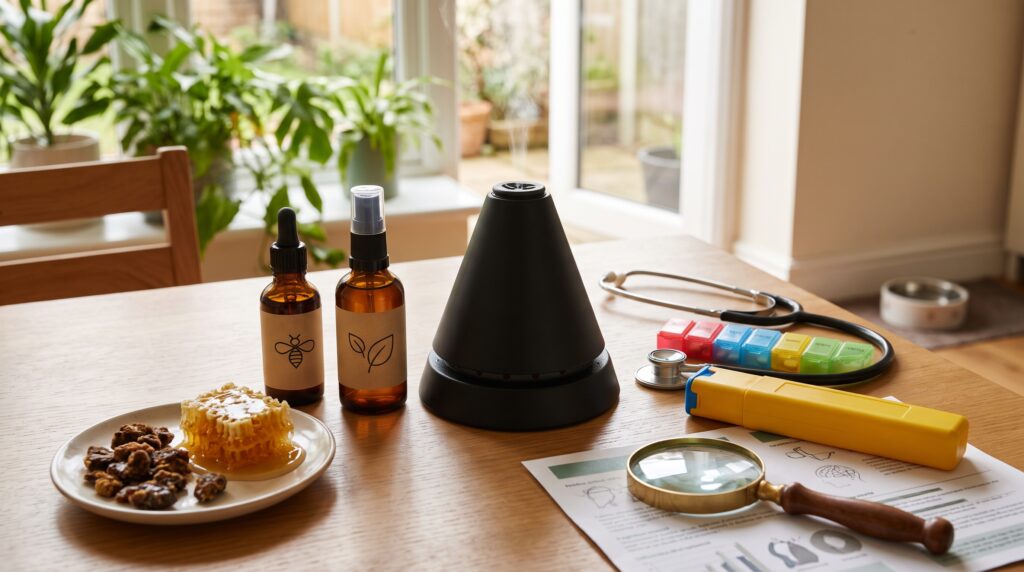
A word on what this article is not. We sell propolis products; we are not clinicians. Nothing here is medical advice, and nothing here is a claim that propolis treats, prevents or cures any condition. Where a question depends on your own health, your medicines or your family, the answer comes from your GP, pharmacist, midwife or vet — not from a shop. What we can do is tell you honestly what our products contain, how they are used, and which questions are worth taking to a professional.
Allergies: the one clear reason to avoid propolis
If there is a single thing to take from this article, it is this one. Propolis is a bee product, and like other bee products it can cause allergic reactions in some people. For a minority, those reactions can be serious.
You should not use propolis in any form, and should not use a propolis diffuser, if you are allergic to bees, bee stings, or bee products such as honey, pollen, royal jelly or beeswax. The same caution applies if you have a known allergy to poplar buds, balsam of Peru or salicylates, as these share compounds with the resins bees gather.
People with a history of asthma, hay fever or multiple allergies are not automatically excluded, but they are the group most likely to react, and they are the group we would most strongly encourage to speak to their GP before starting rather than after.
If you are not sure whether an allergy applies to you, do not guess your way through it. Ask a GP or pharmacist, and mention specifically that you are considering a bee product. If you have ever been prescribed an adrenaline auto-injector for any allergy, that conversation is not optional.
Stop using any propolis product and seek medical advice if you notice a rash, itching, swelling, mouth or throat irritation, wheezing, or any difficulty breathing. If breathing is affected, treat it as an emergency.
We would far rather lose a sale than have someone discover an allergy over their kitchen table.
Children
Parents ask us about children more than any other group, and the honest answer is that it depends on the child’s age and on the format.
Some things are settled. Honey and products containing honey — our propolis syrup among them — are not suitable for infants under twelve months, in line with long-standing NHS guidance. That is a firm line, not a cautious suggestion.
Beyond infancy, the sensible approach is to look at the format rather than at propolis in the abstract. Alcohol-based tinctures are not a good match for young children; our alcohol-free tincture exists partly for that reason. Throat sprays vary, and the directions on each individual product are what govern how and whether it is used. Diffusing is the gentlest option in practice, because nothing is swallowed and the child is simply in the room.
Whatever the format, read the label on the specific product you own. Age guidance is printed there for a reason, and it is more reliable than anything a general article can tell you.
And before a child uses any propolis product for the first time, check with your GP, health visitor or pharmacist — particularly if the child has asthma, eczema or any known allergy. We have written about this in more detail in our guide to propolis family care.
Pregnancy and breastfeeding
Here we will give you the answer you probably did not want: there is not enough good evidence either way, and we are not going to invent some.
Propolis has not been well studied in pregnancy or while breastfeeding. That is not the same as saying it is dangerous, and it is certainly not the same as saying it is fine. It means the question cannot be answered responsibly by a company selling the product.
So our position is simple. If you are pregnant, trying to conceive or breastfeeding, speak to your midwife, GP or pharmacist before using any propolis product, including diffusing. Take the actual product with you, or a photograph of the label, so they can see the ingredients and the alcohol content rather than relying on a general description.
If you would rather not have that conversation, that is a perfectly reasonable signal to wait.
Medicines and existing conditions
If you take prescribed medication, check with your pharmacist or GP before adding any supplement to your routine. Propolis is no exception, and a pharmacist can answer this in a two-minute conversation at the counter.

It is worth being particularly deliberate about that conversation if you are taking anticoagulants or antiplatelet medicines, if you are due an operation or dental surgery, if you are on immunosuppressants, or if you are already managing a long-term condition with several medicines. Your pharmacist has your full medication record; we do not.
The alcohol content of tinctures is also worth raising. If you are avoiding alcohol for medical, personal or religious reasons, or if you take a medicine that does not sit well with alcohol, say so — there is an alcohol-free option, and it is a straightforward swap.
Finally, propolis is a food supplement, not a substitute for prescribed treatment. Do not stop or change anything your doctor has prescribed in order to try it, and do not delay getting medical attention for a symptom that concerns you.
Diffusing at home: rooms, run times and the people you live with
A diffuser is different from a tincture or a spray in one important respect: it does not only involve the person who bought it. Everyone in the room is in the room.
That changes the etiquette more than anything else. If you live with other people, tell them before you switch it on, and make sure nobody in the household falls into the allergy group described above. A guest who has never mentioned a bee allergy has never been asked.
On the practical side, follow the run times and capsule guidance for your particular model rather than leaving it running indefinitely — our diffuser capsules guide sets out what each blend is intended for and how long a capsule lasts, and the Propol Therapy A4 has its own rules. Match the device to the room size rather than putting a large unit in a small box room, keep some ventilation, and build up gradually rather than starting with a long first session.
If anyone in the room develops a cough, irritation or any breathing difficulty, switch it off, open a window and let the air clear. Do not persist on the assumption that it will settle.
Bedrooms are worth a separate thought. Some people like a short session before bed; a diffuser running unattended all night in a closed room is a different proposition, and we would not recommend it. As with any electrical appliance, keep it on a stable surface, out of reach of children, away from water, and switched off when you leave the house.

Pets
Cat owners in particular tend to arrive at this question already worried, and with good reason. Essential oil diffusers have a genuinely poor reputation around cats, who process certain compounds differently from us, and anyone who has read about that is right to ask before plugging anything in.
So it is worth being clear about what a propolis diffuser is. It warms a propolis capsule rather than nebulising essential oils, and propolis is a bee resin, not an essential oil. It is a different product doing a different thing, and the warnings written about essential oil diffusers were not written about this.
That said, we are not going to turn that distinction into a promise. Propolis diffusers have not been studied in cats, dogs, rabbits or birds in any way that would let us tell you they are safe for your animal, and birds in particular have respiratory systems so sensitive that caution around anything airborne is the norm.
What we would suggest instead is this. Ask your vet first, especially if your animal has any respiratory condition — they know your pet and can give you an answer we cannot. Keep the door open so the animal can leave the room if it wants to, and never shut a pet in with a running diffuser. Start with a short session and watch how your animal behaves. Keep capsules, tinctures and sprays well out of reach, as you would any supplement. And if your pet coughs, sneezes, drools or seems unsettled, switch the diffuser off and ring your vet.
If any of that sits uncomfortably with you, the oral formats keep the question off the table entirely.
Alcohol-based or alcohol-free?
This is not strictly a safety question, but it is the one that decides whether a product is appropriate for a particular household, so it belongs here.
Traditional propolis tinctures use alcohol to extract and hold the resin. It is an effective method with a long history, and for many people it is simply the standard option.
An alcohol-free version makes more sense if the product is for a child, if you are avoiding alcohol for medical, personal or religious reasons, if you find alcohol tinctures harsh on the throat, or if you take a medicine where alcohol is best avoided.
Whichever you lean towards, the directions and the alcohol content are printed on the bottle, and they are what should guide you. Our guide to taking propolis tincture compares the two side by side, and the throat spray guide does the same for sprays.
How to start sensibly
Assuming you have cleared the allergy question and spoken to a professional where this article has suggested it, the rest is mostly common sense.
Start with one product rather than three. If something does not agree with you, you want to know which thing it was.
Begin at the lower end of the directions on the label and stay there for the first few days. With a diffuser, that means a short first session rather than a full programme. With tinctures and sprays, it means the smaller amount the label allows.
Some people like to try a little on the inside of the forearm first and leave it for a day, in the same way you might with a new skin product. It is not a medical test and it will not rule out a reaction, but it costs nothing.
Keep an eye on how you feel over the first week, and stop if anything seems off. Store everything out of reach of children and away from heat and direct sunlight, and keep to the directions on the label rather than a figure you read somewhere online — including here.
What to look for on the label
One last point, because it bears on all of the above: you cannot make a sensible decision about a product whose contents you do not know.
A label worth trusting tells you where the propolis came from, since composition varies considerably with the region and the trees the bees worked — we have written about this in types of propolis. It lists the full ingredients, including the alcohol content where there is any. It carries clear directions and age guidance. And it names the responsible company with an address you could actually write to.
Certification helps too, because it means someone independent has checked the claim rather than the seller asserting it. Our organic certificate article explains what the certification covers and, just as usefully, what it does not.
If a product cannot tell you these things, the safety questions in this article have no reliable answer for it — whoever is selling it.

Frequently asked questions
Can I use propolis if I am allergic to honey? No. If you are allergic to honey, bee stings or other bee products, avoid propolis in all forms, including diffusing, and speak to your GP if you are unsure about your allergy.
Is a propolis diffuser the same as an essential oil diffuser? No. It warms a propolis capsule rather than nebulising essential oils, so the specific warnings written about essential oil diffusers do not apply to it. That is a difference in what the device does, not a safety guarantee.
Can I run a diffuser around my cat or dog? Ask your vet first, particularly if your animal has a respiratory condition. If you do use one, leave the door open, keep sessions short at first and watch how your pet responds.
Can children use propolis? It depends on age and format. Honey-containing products, including propolis syrup, are not suitable under twelve months. For older children, follow the age guidance on the specific product and check with your GP, health visitor or pharmacist first.
Can I use propolis while pregnant? There is not enough evidence for us to answer that. Speak to your midwife or GP before using any propolis product during pregnancy or while breastfeeding.
Does propolis interact with medication? Check with your pharmacist or GP before adding any supplement if you take prescribed medicines, particularly anticoagulants, or if you have surgery coming up.
Can I use a propolis diffuser overnight? We would not recommend leaving one running unattended all night in a closed room. Follow the run times for your model, and keep some ventilation.
Where to go from here
If you are still building a picture of what propolis actually is — how bees make it, what it is composed of and why that composition varies — our article on what propolis is is the fullest explanation on the site and the best place to start. If none of the cautions above apply to you, the next question is simply which format suits the way you live: capsules for a diffuser, or a spray, tincture or syrup to take by mouth. Our guide to propolis formats walks through the differences, and our FAQs cover the practical side of owning a diffuser.
If something here left you unsure, write to us before you buy rather than after. We would rather answer a question than process a return.
This article is general information about our products and is not medical advice. It is not intended to diagnose, treat, cure or prevent any disease. Propolis products are food supplements and are not a substitute for a varied diet, a healthy lifestyle or treatment prescribed by a healthcare professional. If you have a health concern, are pregnant or breastfeeding, take prescribed medication, or are buying for a child, speak to your GP, pharmacist or midwife. Always read the label and follow the directions supplied with the product. Keep out of the sight and reach of children.
